9 Ball Two Way Shots: Make the Ball or Leave Your Opponent in Trouble
Quick answer: A two way shot in 9 ball is a shot where you try to make the ball, but you also plan where the cue ball and object ball will end up if you miss. If the ball goes in, you keep shooting. If it misses, your opponent is left with a hard shot or a safety. Two way shots are smart when the shot is hard and a straight safety would give up too much. The key is controlling speed so both balls end up in good spots.
Strong 9 ball players use two way shots a lot. They are a way to take a chance without handing over the table.
Two Way Shot vs Safety vs Offense
| Choice | Goal | When to use it |
|---|---|---|
| Offense | Make the ball and get position | Easy or medium shots |
| Two way shot | Try to make it, leave a safety if you miss | Hard shots with a safe miss |
| Safety | Do not try to make it, leave your opponent stuck | Very hard shots or no good options |
To learn more about safeties, read 9 ball safety shot.
When to Play a Two Way Shot
- The shot is hard, like a long cut or a thin cut.
- If you miss, the object ball can roll to a safe area.
- The cue ball can end up behind a blocker or far from the object ball.
- Your opponent is strong and will likely run out from an easy leave.
How to Plan a Two Way Shot
- Pick the shot. Decide which pocket you will try.
- Picture a miss. Where will the object ball go if it misses the pocket?
- Plan the cue ball. Can you send it to a long rail, behind another ball, or far from the object ball?
- Pick a speed. Speed decides where both balls stop. Soft speed is often best.
- Commit and shoot. Do not change your mind during the stroke.
Simple Two Way Examples
- Long cut along the rail: if you miss, the object ball stays on the rail at the far end, and the cue ball comes back to the other end, leaving a long, hard shot.
- Thin cut near a corner: if you miss, the object ball rolls up table, and the cue ball stays near the bottom rail behind a blocker.
- Bank shot: some players try a bank where a miss leaves the object ball near the far rail and the cue ball near the head rail. For kicking ideas, see how to kick at a ball in pool.
Two Way Shots and the Push Out
In many 9 ball rules, the player who shoots after the break can choose to push out. A push out is a shot to a new spot instead of hitting the lowest ball. Your opponent then chooses who shoots next. Thinking in two way terms helps you pick a smart push out spot. Read the rules for your game, since rules vary.
Speed Control Is the Key
A two way shot only works if your speed is right. Too hard and both balls may end up near the middle of the table. Practice speed with simple drills, like rolling the cue ball to a target. See 9 ball pattern play for position ideas.
Practice Drill
- Set up a long cut shot with a blocker ball near the far rail.
- Try to make the shot and send the cue ball behind the blocker.
- Note where both balls end up, make or miss.
- Repeat until you can leave a tough shot on most misses.
For more practice ideas, read how to practice 9 ball alone.
Common Mistakes
- Hitting too hard and leaving an easy shot
- Planning the miss but forgetting the cue ball
- Using two way shots on easy balls you should just make
The Bottom Line
9 ball two way shots let you go for a hard ball while planning a safe leave if you miss. Picture the miss, plan where the cue ball ends up, and control your speed. Used well, two way shots win games without big risks.
Keep Reading on This Site
- 9 Ball Cue Ball Control: How to Get Shape on the Next Ball Every Time
- 9 Ball Rules for Beginners: A Simple Guide to Play Today
- Common 9 Ball Mistakes and How to Fix Them
- 9 Ball Pattern Play: How to Plan Your Run From the 1 to the 9
- 9 Ball Strategy for Beginners: 8 Simple Ideas to Win More Racks
- How to Rack 9 Ball: A Simple Step by Step Guide
Frequently Asked Questions
What is a two way shot in 9 ball?
It is a shot where you try to make the ball but plan a safe leave for your opponent if you miss.
When should I play a two way shot?
When the shot is hard and a miss can leave the object ball and cue ball in safe spots.
Is a two way shot the same as a safety?
No. A safety does not try to make the ball. A two way shot tries to make it and leaves a safety on a miss.
What is the most important part of a two way shot?
Speed control, because speed decides where both balls stop.
How to Practice 9 Ball Alone: 6 Solo Drills That Build Real Skill
Quick answer: To practice 9 ball alone, use drills with a score you can beat. Try breaking and running out from ball in hand, playing the ghost, running three or four ball patterns, practicing your break, working on safeties, and finishing with pressure shots. Keep a notebook of your scores. A focused 30 to 60 minute session with clear goals will help you more than shooting random balls.
You do not need an opponent to get better at 9 ball. In fact, solo practice lets you repeat the exact shots you miss most.
Drill 1: Play the Ghost
The ghost is an imaginary player who never misses. Break, take ball in hand, and try to run the rack. If you miss, the ghost wins that rack. Play a race to five or seven. Read 9 ball ghost drill for the full drill.
Goal: Beat the ghost more often each week.
Drill 2: Three Ball Patterns
Toss three balls on the table. Take ball in hand and run them in order. Then try four, five, and six balls.
Goal: Run three balls 8 out of 10 times before moving up. This builds 9 ball pattern play.
Drill 3: Break Practice
Rack and break 20 times. Write down if a ball went in, where the 1 ball went, and where the cue ball stopped.
Goal: Make a ball and keep the cue ball near the center. See how to break in 9 ball.
Drill 4: Position Zone Drill
Set up one ball. Put a coin or chalk where you want the cue ball to stop for the next shot. Shoot and see how close you come.
Goal: Land within a hand width of the target most of the time.
Drill 5: Safety Practice
Place the lowest ball and a blocker ball. Try to hit the lowest ball and hide the cue ball behind the blocker.
Goal: Leave no clear shot on the lowest ball 6 out of 10 times. See 9 ball safety shot.
Drill 6: Pressure Finish
End each session by setting up the 8 and the 9 with ball in hand. Tell yourself you must make both to finish. Miss and you set it up again.
Goal: Finish in as few tries as you can. This builds calm under pressure.
A Sample Solo Session
| Time | Drill |
|---|---|
| 5 minutes | Warm up with easy straight shots |
| 10 minutes | Three ball patterns |
| 10 minutes | Break practice |
| 10 minutes | Safety practice |
| 15 minutes | Play the ghost |
| 5 minutes | Pressure finish |
Tips for Better Solo Practice
- Keep score. Numbers show your real progress.
- Use your full pre shot routine every time.
- Work on weak spots. If you miss long shots, practice long shots.
- Practice kicks too. See how to kick at a ball in pool.
- Rest your eyes for a minute between drills.
Learn From Your Misses
When you miss, ask why. Was it aim, speed, or a poor position choice? Many players repeat the same errors. Read common 9 ball mistakes and build drills to fix the ones you make.
Do Not Forget the Rules
Solo practice is a good time to learn the rules, too. Brush up with 9 ball rules for beginners so you play correctly when you get back to matches.
The Bottom Line
You can practice 9 ball alone with drills like playing the ghost, ball patterns, break practice, position zones, safeties, and pressure finishes. Keep score, use your full routine, and focus on your weak spots. A short session with clear goals will build skills that show up in real matches.
Keep Reading on This Site
- 9 Ball Rules for Beginners: A Simple Guide to Play Today
- Common 9 Ball Mistakes and How to Fix Them
- 9 Ball Pattern Play: How to Plan Your Run From the 1 to the 9
- 9 Ball Strategy for Beginners: 8 Simple Ideas to Win More Racks
- How to Rack 9 Ball: A Simple Step by Step Guide
- How to Break in 9 Ball: 8 Tips for a Better Break
Frequently Asked Questions
What is the ghost drill in 9 ball?
You play against an imaginary player who never misses. If you fail to run the rack, the ghost wins it.
How long should I practice 9 ball alone?
Thirty to sixty focused minutes is plenty for most players.
What should I practice first in 9 ball?
Start with short ball patterns and cue ball control, then add break and safety work.
Is solo practice as good as playing others?
Both help. Solo drills build skills, and playing others puts those skills to work under pressure.
10 Ball vs 9 Ball: The Key Differences Explained Simply
Quick answer: 9 ball and 10 ball are both rotation games, which means you must hit the lowest numbered ball on the table first. 9 ball uses nine balls in a diamond rack, and in many rules you can win by making the 9 ball on any legal shot, even on the break. 10 ball uses ten balls in a triangle rack, and it is usually played as a call shot game. In many 10 ball rules, making the 10 on the break does not win; it is spotted. That makes 10 ball harder and less about luck.
If you already play 9 ball, 10 ball will feel familiar. The changes are small but important.
Side by Side
| Feature | 9 ball | 10 ball |
|---|---|---|
| Balls | 1 through 9 | 1 through 10 |
| Rack shape | Diamond | Triangle |
| Ball on the front spot | 1 ball | 1 ball |
| Ball in the middle | 9 ball | 10 ball, in the middle of the third row |
| Hit lowest ball first | Yes | Yes |
| Call shot | Depends on the rules, often not | Usually yes |
| Money ball on the break | Often wins | Often spotted, not a win |
Rules can be different by league, so always check before you play. For more about calling shots in 9 ball, read 9 ball call shot vs slop.
The Rack
In 9 ball, the balls form a diamond with the 1 ball at the front and the 9 in the middle. See how to rack 9 ball. In 10 ball, you use a regular triangle rack with the 1 ball at the front and the 10 ball in the middle of the third row.
The Break
The 10 ball rack is tighter and has more balls, so it can be harder to make a ball on the break. Many players find 10 ball breaks less predictable than 9 ball breaks. For 9 ball breaking tips, see how to break in 9 ball.
Call Shot
Many 10 ball rules ask you to call your ball and pocket. If you make a ball in a different pocket than called, it may not count, and your turn can end. In 9 ball, many casual and some league games let any ball that goes in count. That is why 10 ball is often called a game of skill over luck.
Which Game Is Harder?
Most players say 10 ball is harder because:
- There is one more ball to run.
- The break is less likely to give you an easy start.
- Call shot rules take away lucky shots.
Which Should You Play?
- Play 9 ball if you want a fast game and a classic league format.
- Play 10 ball if you want to test your skill and cut down on luck.
Both games build great rotation skills. Learn more strategy in 9 ball strategy for beginners and compare with 8 ball in 9 ball vs 8 ball.
Tips When Switching to 10 Ball
- Call every shot clearly.
- Play more safeties early in the rack.
- Plan the pattern from the start, since there is one more ball.
- Practice your break with a triangle rack.
The Bottom Line
10 ball and 9 ball are both rotation games where you hit the lowest ball first. 9 ball uses a diamond rack and often lets the 9 win on any legal shot. 10 ball uses a triangle rack, is usually call shot, and often spots the 10 if it goes in on the break. Check the rules you play by, and enjoy both games.
Keep Reading on This Site
- Common 9 Ball Mistakes and How to Fix Them
- 9 Ball Pattern Play: How to Plan Your Run From the 1 to the 9
- 9 Ball Strategy for Beginners: 8 Simple Ideas to Win More Racks
- How to Rack 9 Ball: A Simple Step by Step Guide
- How to Break in 9 Ball: 8 Tips for a Better Break
- How to Run Out in 9 Ball: 7 Steps to Plan Your Pattern
Frequently Asked Questions
What is the main difference between 9 ball and 10 ball?
10 ball has one more ball, uses a triangle rack, and is usually played call shot.
Can you win 10 ball on the break?
In many 10 ball rules, the 10 ball made on the break is spotted and does not win. Check your rules.
Is 10 ball harder than 9 ball?
Most players think so, because of the extra ball, the tougher break, and call shot rules.
How do you rack 10 ball?
Use a triangle rack with the 1 ball at the front and the 10 ball in the middle of the third row.
9 Ball Golden Break: What It Is and Why It Wins the Rack
Quick answer: A golden break in 9 ball is when the 9 ball goes into a pocket on a legal break shot. Under most 9 ball rules, that wins the rack right away. The break must be legal, which usually means the cue ball hits the 1 ball first, and you must not scratch or foul. If you foul on the break while making the 9, the 9 is usually spotted and your opponent gets ball in hand.
A golden break is one of the most exciting shots in 9 ball. It ends the game before your opponent even gets a turn.
What Makes a Break Legal?
Rules differ, but many rule sets require:
- The cue ball must hit the 1 ball first
- At least one ball must be pocketed, or a set number of balls must hit a rail
- The cue ball must not scratch or leave the table
Check your league or house rules before you play. See how to break in 9 ball for more on the break.
Golden Break vs Foul
| What happens on the break | Common result |
|---|---|
| 9 goes in, legal break | Breaker wins the rack |
| 9 goes in, breaker scratches | 9 is spotted, opponent gets ball in hand |
| 9 goes in, cue ball misses the 1 | Foul, 9 is spotted |
Can You Plan a Golden Break?
Not exactly. Any break has a lot of luck. But a good rack and a solid break can give you more chances for balls to drop.
Tips for a Strong 9 Ball Break
- Make sure the rack is tight. The balls should touch. Learn how to rack 9 ball.
- Hit the 1 ball square. A full hit sends energy through the rack.
- Use a controlled speed. Hitting as hard as you can may cost you control. Find a speed where you still hit the 1 ball solidly.
- Keep the cue ball near the center. A cue ball that stays in the middle of the table is less likely to scratch and gives a better next shot.
- Try different break spots. Many players break from near the side rail. Experiment and see what works best for you.
Where the 9 Ball Goes
The 9 ball sits in the middle of the rack, so it gets hit from many sides on a strong break. Results vary with the rack, the table, and the break.
What If the 9 Does Not Drop?
That is the usual result. Then you shoot the lowest numbered ball on the table. Plan your run with good patterns. See 9 ball pattern play and how to run out in 9 ball.
Push Out After the Break
In many rules, the player shooting right after the break can choose a push out. Learn more in 9 ball rules push out.
Golden Break in Other Games
The term is used in other games too. In some 8 ball rules, making the 8 on the break is a win. In 10 ball, many rules do not count the 10 on the break as a win. Always check the rules for the game you are playing.
The Bottom Line
The 9 ball golden break is when the 9 goes in on a legal break, which wins the rack under most rules. Hit the 1 ball first, avoid a scratch, and check your house rules. You cannot plan a golden break, but a tight rack and a solid, controlled break give you the best chances.
Keep Reading on This Site
- 9 Ball Pattern Play: How to Plan Your Run From the 1 to the 9
- 9 Ball Strategy for Beginners: 8 Simple Ideas to Win More Racks
- How to Rack 9 Ball: A Simple Step by Step Guide
- How to Break in 9 Ball: 8 Tips for a Better Break
- How to Run Out in 9 Ball: 7 Steps to Plan Your Pattern
- 9 Ball Three Foul Rule: How It Works and How to Use It
Frequently Asked Questions
What is a golden break in 9 ball?
It is when the 9 ball goes in on a legal break, which wins the rack under most rules.
What happens if you scratch on a golden break?
Under most rules, the 9 is spotted and your opponent gets ball in hand.
Can you aim for a golden break?
Not exactly, since breaks have a lot of luck. A tight rack and a solid hit on the 1 ball help.
Is a golden break allowed in all leagues?
Most rules count it as a win, but some leagues have different rules. Always check.
9 Ball Call Shot vs Slop: Which Rules Are You Playing?
Quick answer: In 9 ball, “slop” means any ball that goes in on a legal shot counts, even if you did not plan it. “Call shot” means you must say which ball goes in which pocket, at least for some shots, and only called balls count. Many standard 9 ball rules do not require calling shots. Some leagues, pool rooms, and players do use call shot rules, often for the 9 ball. Always agree on the rules before you play.
Arguments about luck shots are common in pool halls. Knowing the difference between call shot and slop helps you avoid them.
What Is Slop?
In a slop game, as long as you hit the lowest numbered ball first and the shot is legal, any ball that falls counts. If the 9 goes in by luck on a legal shot, you win.
Pros:
- Simple rules
- Fast games
- Fewer arguments about what was called
Cons:
- Luck can decide a rack
- Lucky shots can feel unfair
What Is Call Shot?
In call shot 9 ball, the shooter must name the ball and the pocket. If a different ball goes in, or the called ball goes in a different pocket, the rules decide what happens. Often the shooter’s turn ends, and in some rules the ball may be spotted.
Pros:
- Rewards skill over luck
- Makes players plan shots
Cons:
- More rules to agree on
- Can slow the game down
Side by Side
| Slop | Call shot | |
|---|---|---|
| Lucky balls count? | Yes, on a legal shot | No, only called balls |
| Calling needed? | No | Yes |
| Speed of game | Faster | A bit slower |
| Common in | Many standard rule sets, casual play | Some leagues, rooms, and money games |
Calling Only the 9
Some players use a middle ground: everything is slop except the 9. You must call the 9 before shooting it. This keeps the game fast but stops lucky wins on the 9. If the 9 goes in without being called, a common house rule is to spot it and keep playing. Check your local rules.
How to Call a Shot
- Point with your cue or say it out loud: “9 in the corner.”
- Obvious shots often do not need calling in casual play, but say it if there is any doubt.
- Banks and combos should always be called clearly in call shot games.
Why It Matters to Agree First
Most arguments happen after a lucky shot. Settle the rules before the first break:
- Is it slop or call shot?
- If call shot, is it every ball or just the 9?
- What happens if an uncalled ball goes in?
- Is there a three foul rule? See our page on the 9 ball three foul rule.
How the Rules Change Strategy
In slop games, players may shoot hard combos and hope something drops. In call shot games, players think more about safeties and clear plans. Either way, good position play matters. Our page on how to run out in 9 ball covers the basics.
Calling Shots in 8 Ball
8 ball is often played call shot, especially on the 8. If you play both games, remember that the rules can differ. Our post comparing 9 ball vs 8 ball explains other key differences.
The Bottom Line
9 ball call shot vs slop comes down to whether lucky balls count. In slop, any ball made on a legal shot counts. In call shot, only called balls count. Many standard rules play slop, but many leagues and rooms use some form of call shot, often just on the 9. Agree on the rules before you break, and you will avoid most arguments.
Keep Reading on This Site
- 9 Ball Strategy for Beginners: 8 Simple Ideas to Win More Racks
- How to Rack 9 Ball: A Simple Step by Step Guide
- How to Break in 9 Ball: 8 Tips for a Better Break
- How to Run Out in 9 Ball: 7 Steps to Plan Your Pattern
- 9 Ball Three Foul Rule: How It Works and How to Use It
- 9 Ball Combination Shot: How to See It and Make It in 5 Steps
Frequently Asked Questions
What does slop mean in 9 ball?
It means any ball that goes in on a legal shot counts, even if you did not plan it.
Do you have to call shots in 9 ball?
Many standard rules do not require it, but some leagues, rooms, and players do.
What happens if the 9 goes in by accident in call shot?
It depends on the rules. A common house rule is to spot the 9 and continue.
Is 8 ball call shot?
8 ball is often played call shot, especially on the 8 ball.
9 Ball vs 8 Ball: The Main Differences Explained
Quick answer: The main difference between 9 ball and 8 ball is how you win. In 8 ball, you pick solids or stripes, clear your group, then sink the 8 ball. In 9 ball, you must always hit the lowest numbered ball first, and you win by pocketing the 9 ball at any time, as long as the shot is legal. 8 ball uses all 15 balls in a triangle rack. 9 ball uses balls 1 through 9 in a diamond rack.
Both games are popular, but they feel very different. Here is how they compare.
Side by Side
| Feature | 8 Ball | 9 Ball |
|---|---|---|
| Balls used | 15 object balls | 9 object balls |
| Rack shape | Triangle | Diamond |
| Groups | Solids or stripes | No groups |
| What to hit first | A ball in your group | The lowest numbered ball on the table |
| How to win | Clear your group, then sink the 8 | Sink the 9 on a legal shot |
| Calling shots | Often required | Often not required, except push outs and some house rules |
How 8 Ball Works
In 8 ball, the table is usually open after the break. Once a player makes a ball, they take that group. You must clear your seven balls and then pocket the 8 ball in the called pocket. Sinking the 8 early, or scratching while shooting it, often loses the game. Our sister site covers how to play 8 ball pool in detail.
How 9 Ball Works
In 9 ball, you must hit the lowest numbered ball first on every shot. You do not have to pocket the balls in order. You only have to hit the lowest ball first. If any ball goes in on a legal shot, you keep shooting. If the 9 goes in on a legal shot, you win, even if other balls are still on the table. Our page on how to play 9 ball pool has the full rules, and our page on the 9 ball combination shot explains early wins.
Other Rule Differences
- Push out. In many 9 ball rules, the player after the break may push out to a new spot. 8 ball does not use this. See our post on the 9 ball push out rule.
- Three foul rule. Some 9 ball rules make you lose if you foul three times in a row. See our page on the 9 ball three foul rule.
- Ball in hand. Both games often give ball in hand after a foul, but house rules vary.
Which Game Is Harder?
Many players find 9 ball harder to run out because you have to hit the balls in order and play position across the whole table. 8 ball has more balls on the table and more strategy around blocking. Both take real skill.
Which Game Should You Learn First?
Many beginners start with 8 ball because it is the common bar and home game. 9 ball is great for building position play since you must think about the next ball every time. Playing both helps your game.
Game Speed
9 ball games are often quicker because there are fewer balls. That is one reason it is popular in tournaments and on video.
The Bottom Line
In 9 ball vs 8 ball, the biggest difference is how you win. 8 ball has solids and stripes and ends with the 8. 9 ball makes you hit the lowest ball first and you win when the 9 goes in legally. 9 ball uses a diamond rack of nine, and 8 ball uses a triangle of fifteen. Try both and see which one you like.
Keep Reading on This Site
- How to Rack 9 Ball: A Simple Step by Step Guide
- How to Break in 9 Ball: 8 Tips for a Better Break
- How to Run Out in 9 Ball: 7 Steps to Plan Your Pattern
- 9 Ball Three Foul Rule: How It Works and How to Use It
- 9 Ball Combination Shot: How to See It and Make It in 5 Steps
- How to Play 9 Ball Pool: 6 Easy Steps and Key Rules
Frequently Asked Questions
What is the main difference between 9 ball and 8 ball?
In 8 ball you clear solids or stripes then sink the 8. In 9 ball you hit the lowest ball first and win by sinking the 9 legally.
Do you have to pocket balls in order in 9 ball?
No. You must hit the lowest numbered ball first, but balls can go in any order.
Is 9 ball harder than 8 ball?
Many players find 9 ball harder to run out because of the order rule, but both take skill.
How many balls are used in 9 ball?
9 ball uses the object balls numbered 1 through 9 plus the cue ball.
The 9 Ball Ghost Drill: How to Play the Ghost and Track Your Progress
Quick answer: In the 9 ball ghost drill, you play against an imaginary opponent called the ghost who never misses. You break, then take ball in hand and try to run the rack. If you clear all the balls, you win the rack. If you miss or foul, the ghost wins. Play a set number of racks, like a race to 5 or 10 games, and track your score over time.
Practicing alone can get boring. The ghost turns practice into a real game with pressure, and it gives you a clear way to see if you are getting better.
The Basic Rules
- Rack the 9 balls.
- Break.
- Take ball in hand anywhere on the table.
- Shoot the balls in order, starting with the lowest numbered ball.
- If you clear the table, you win the rack.
- If you miss, foul, or scratch, the ghost wins the rack.
Most players give themselves ball in hand after the break so every rack is a fair chance to run out.
How to Keep Score
| Match | Goal |
|---|---|
| Race to 5 against the ghost | Good for shorter sessions |
| Race to 10 | Good for longer sessions |
| 10 racks, count wins | Easy to track progress |
Write the score in a notebook or on your phone each time.
Easier Versions for Beginners
The full ghost is hard. Start with fewer balls.
| Version | How It Works |
|---|---|
| 6 ball ghost | Rack 1 through 6, ball in hand after break |
| Ball in hand anytime once | You get one extra ball in hand per rack |
| Two misses allowed | The ghost wins only after your second miss |
Move up once you win often.
What the Ghost Teaches
- Pattern play. You learn to plan the whole rack, not just one ball.
- Position. Small mistakes add up fast.
- Pressure. Every miss costs a game.
- Honest feedback. The score shows where you really are.
Tips for Beating the Ghost
- Plan the first three balls before you shoot.
- Use ball in hand wisely. Pick a spot that sets up an easy angle for the next ball.
- Keep the cue ball near the center when you can.
- Avoid big cue ball moves. Simple position is usually safer.
- Shoot at your normal pace. Do not rush just because you are alone.
Track Your Progress
| Week | Racks Played | Racks Won |
|---|---|---|
| 1 | ||
| 2 | ||
| 3 | ||
| 4 |
Compare weeks, not single days. Some days are better than others.
Make It Harder
- No ball in hand after the break. Play from wherever the cue ball lands.
- Call every pocket.
- Play a race to 10 and count only perfect runs.
Ghost Drill Mistakes to Avoid
Do not give yourself extra chances without writing them down, or your score will not be honest. Do not skip racks that feel too hard, because those are often the ones that teach the most. Do not play when you are very tired, since tired play does not show your real level. Most of all, do not get upset when the ghost wins. Every player loses to the ghost. The goal is to slowly win more often over time.
The Bottom Line
The 9 ball ghost drill turns practice into a game. Break, take ball in hand, and try to run out against an opponent who never misses. Start with fewer balls if needed, keep score, and watch your run outs improve over time.
Keep Reading on This Site
- How to Break in 9 Ball: 8 Tips for a Better Break
- How to Run Out in 9 Ball: 7 Steps to Plan Your Pattern
- 9 Ball Three Foul Rule: How It Works and How to Use It
- 9 Ball Combination Shot: How to See It and Make It in 5 Steps
- How to Play 9 Ball Pool: 6 Easy Steps and Key Rules
- What Is Ball in Hand in 9 Ball? 6 Things Every Player Should Know
Frequently Asked Questions
What is the 9 ball ghost drill?
A practice game where you try to run racks against an imaginary opponent who wins whenever you miss.
Do you get ball in hand in the ghost drill?
Most players take ball in hand after the break so every rack is a fair chance to run out.
Is the ghost drill too hard for beginners?
Start with fewer balls, like 6 ball ghost, and move up once you win often.
How often should I play the ghost?
Play it regularly and track your score so you can see progress over weeks.
What Is Ball in Hand in 9 Ball? 6 Things Every Player Should Know
Quick answer: Ball in hand in 9 ball means you get to pick up the cue ball and place it anywhere on the table before you shoot. Under most standard 9 ball rules, you get ball in hand when your opponent fouls. Common fouls include scratching, not hitting the lowest numbered ball first, and not driving a ball to a rail after contact. Ball in hand is a big advantage, because you can put the cue ball in the perfect spot for your next shot.
Ball in hand is one of the most important rules in 9 ball. It is what makes fouls so costly. Here is what it means and how to use it well.
1. What Is Ball in Hand?
Ball in hand means the cue ball is yours to place. You can pick it up and set it anywhere on the playing surface. Then you shoot from that spot. Under most standard 9 ball rules, ball in hand after a foul is anywhere on the table, not just behind the head string.
2. What Fouls Give Ball in Hand?
Under many standard rules, these are common fouls in 9 ball:
- Scratching. The cue ball goes in a pocket or off the table.
- Wrong ball first. The cue ball does not hit the lowest numbered ball first.
- No rail. After the cue ball hits the right ball, no ball goes in and no ball hits a rail.
- Touching balls. You touch a ball with your hand, clothes, or cue by accident.
- Both feet off the floor. Some rule sets call this a foul.
When your opponent fouls, you get ball in hand. Rules can be different in leagues and bars, so always check.
3. Where Can You Place the Cue Ball?
Under most standard rules, you can place it anywhere on the table. Some house rules limit ball in hand to behind the head string, also called the kitchen, after certain fouls. The break is also a special case in some rule sets. Agree on this before you play.
4. How Do You Place the Cue Ball?
You can use your hand or the tip of your cue to move the cue ball into place. Be careful. If you are moving it with your cue and you touch another ball, that can be a foul. Many players place it by hand to be safe.
5. How to Use Ball in Hand Well
Ball in hand is a gift. Here is how to make the most of it:
- Do not just place it for an easy shot. Think about the next ball too.
- Leave a small angle. A straight in shot can make it hard to move the cue ball to the next ball.
- Fix a problem. If two balls are stuck together, use ball in hand to set up a shot that breaks them apart.
- Look for a safety. If the lowest ball can not be made, ball in hand can be used to play a great safety.
6. Why Fouls Matter So Much in 9 Ball
Because you get ball in hand anywhere on the table, one foul can give your opponent an easy path to run out. That is why good 9 ball players work hard to avoid fouls, and why a good safety that forces a foul is so strong.
Three Foul Rule
Some rule sets have a three foul rule. If a player fouls three times in a row, they lose the rack. Many rule sets require a warning after the second foul. See our page on the 9 ball three foul rule for more.
Quick Summary
| Question | Common standard answer |
|---|---|
| What is ball in hand? | Placing the cue ball anywhere you want |
| When do you get it? | After your opponent fouls |
| Where can you put it? | Anywhere on the table, under most rules |
| How do you place it? | By hand or carefully with your cue |
| Biggest tip | Plan for the next ball, not just this one |
Practice With Ball in Hand
A good way to practice is to spread three or four balls and take ball in hand on the first one. Place the cue ball so you can make the first ball and get a good shot on the second. Then try to run the rest. This builds the habit of thinking ahead with ball in hand.
Ball in hand can turn a hard rack into an easy one. Learn the rules, avoid fouls, and use it wisely when you get it.
Keep Reading on This Site
- How to Run Out in 9 Ball: 7 Steps to Plan Your Pattern
- 9 Ball Three Foul Rule: How It Works and How to Use It
- 9 Ball Combination Shot: How to See It and Make It in 5 Steps
- How to Play 9 Ball Pool: 6 Easy Steps and Key Rules
- How to Kick at a Ball in Pool: A Simple Guide to Kick Shots
- 9 Ball Safety Shot: 6 Simple Ways to Leave Your Opponent Nothing
Frequently Asked Questions
What does ball in hand mean in 9 ball?
It means you can pick up the cue ball and place it anywhere on the table before you shoot.
What gives you ball in hand in 9 ball?
Under most standard rules, any foul by your opponent, such as a scratch or not hitting the lowest ball first.
Is ball in hand anywhere or behind the line?
Under most standard 9 ball rules it is anywhere on the table, but some house rules are different.
Can you move the cue ball with your cue stick?
Many rules allow it, but if you touch another ball while doing it, that can be a foul.
How to Kick at a Ball in Pool: A Simple Guide to Kick Shots
Quick answer: A kick shot is when you hit the cue ball into a rail first so it bounces off and hits the ball you need. You use it when another ball blocks the straight path. For a simple one rail kick, picture the target ball’s mirror image on the other side of the rail, then aim the cue ball at that mirror spot. Use a medium speed with a center ball hit, and adjust after you see how your table plays.
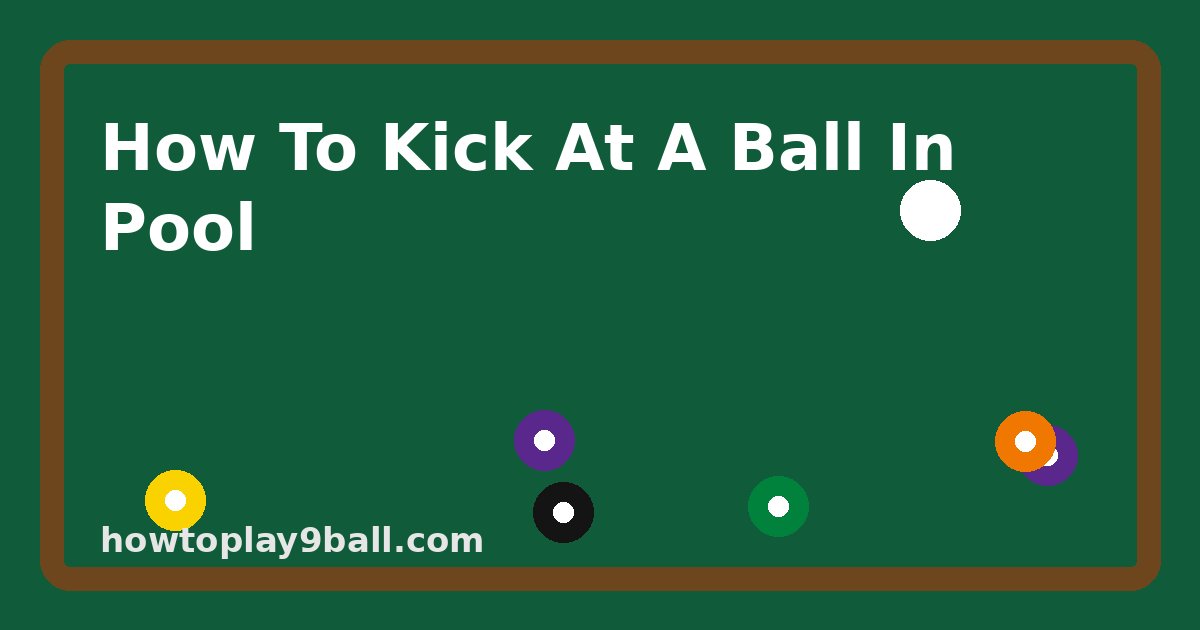
Every player gets snookered sometimes, and in 9 ball it happens a lot because you must hit the lowest numbered ball first. That means a ball is in the way and you cannot hit your target ball directly. In many games, missing the target ball is a foul that can give your opponent ball in hand. A good kick shot gives you a chance to hit the ball, and sometimes even make it.
What Is a Kick Shot?
A kick shot sends the cue ball into one or more rails before it hits the object ball. A bank shot is different. In a bank shot, the object ball goes into the rail. In a kick shot, the cue ball does.
The Mirror Method for One Rail Kicks
This is the easiest way to start.
- Find the rail you want the cue ball to bounce off.
- Picture a mirror along that rail.
- Imagine where the target ball would show up in the mirror. It is the same distance behind the rail as the real ball is in front of it.
- Aim the cue ball straight at that mirror spot.
- The cue ball should hit the rail and bounce toward the real ball.
It works because, in a simple model, a ball comes off the rail at about the same angle it went in. Real tables are not perfect. Speed, spin, and the cushions all change the path a little.
How to Aim Using the Diamonds
The diamonds on the rails help you see the mirror spot. Count diamonds from the corner to the target ball, then find the halfway point on the rail you are kicking off of. Many players learn diamond systems for two and three rail kicks too. Start with the one rail mirror method first.
Speed and Spin
- Use medium speed. Very hard shots can make the cue ball bounce off the rail at a shorter angle. Very soft shots may not get there.
- Hit the cue ball near center. Side spin changes the angle off the rail. Leave it out until you know how it works.
- Think about where the cue ball goes after. If you only need to hit the ball, a softer kick can leave a safe position.
When to Kick and When to Jump
Some players jump over the blocking ball instead. Jump shots need a cue made for jumping and a lot of practice. For most players, a kick shot is the safer choice and works on almost any table.
How to Practice Kick Shots
- Put an object ball near the middle of a short rail.
- Put a blocker ball between it and the cue ball.
- Use the mirror method to kick off a long rail.
- Watch where the cue ball hits. Is it long or short?
- Move the balls and try new angles.
- Write down what you learn about your table.
Common Mistakes
- Guessing the angle. Take time to find the mirror spot.
- Hitting too hard. The angle shortens and control goes away.
- Adding side spin by accident. Check that your tip hits the center of the cue ball.
- Only thinking about the hit. Plan where the cue ball and object ball end up.
Kick shots look fancy, but the basic one rail kick is something any player can learn. A little practice turns a foul into a fair hit, and that can change a game.
Keep Reading on This Site
- 9 Ball Three Foul Rule: How It Works and How to Use It
- 9 Ball Combination Shot: How to See It and Make It in 5 Steps
- How to Play 9 Ball Pool: 6 Easy Steps and Key Rules
- 9 Ball Safety Shot: 6 Simple Ways to Leave Your Opponent Nothing
- How Straight Pool Works and Why It Has an 832 Ball Record
- 9 Ball Rules Push Out: What It Is and 5 Tips to Use It
Frequently Asked Questions
What is the difference between a kick shot and a bank shot?
In a kick shot, the cue ball hits a rail before the object ball. In a bank shot, the object ball hits a rail on its way to the pocket.
How do you aim a kick shot?
For a one rail kick, picture the target ball's mirror image behind the rail and aim the cue ball at that mirror spot.
What speed should I use for a kick shot?
Medium speed is a good place to start. Very hard shots can change the angle off the rail.
Should I use spin on a kick shot?
Start with a center ball hit. Side spin changes the angle, so add it only after you learn how it works.
9 Ball Safety Shot: 6 Simple Ways to Leave Your Opponent Nothing
Quick answer: A 9 ball safety shot is a legal shot where you do not try to make a ball. Instead, you hit the lowest ball and leave the cue ball where your opponent cannot see or easily hit the next lowest ball. Because a foul gives ball in hand, a good safety can win you the game on the next turn.
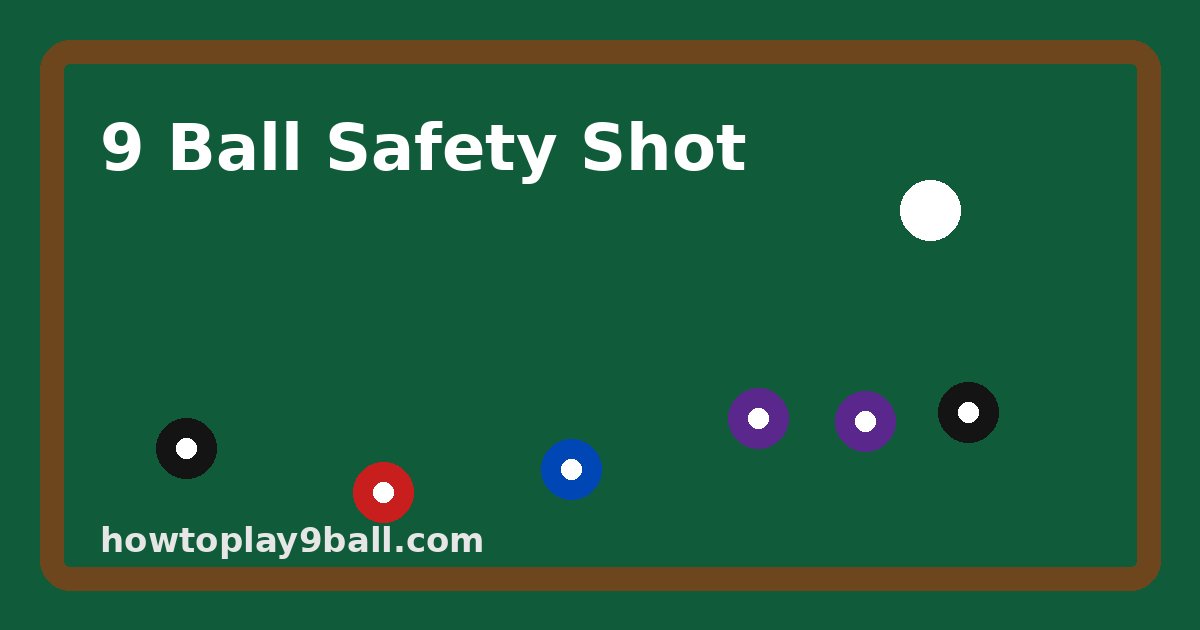
Nine ball has ball in hand for any foul. That makes safeties very strong. If your opponent fouls, you can put the cue ball anywhere. Here is how to play smart safeties.
Remember the Rule
On every shot in 9 ball, the cue ball must hit the lowest numbered ball first. After that, a ball must go in or some ball must hit a rail. If not, it is a foul. Your safety must follow these rules too.
6 Ways to Play a Safety
- Hide behind a ball. Hit the lowest ball, then roll the cue ball behind another ball so the next lowest ball is blocked.
- Send the object ball far away. Hit the lowest ball to the other end of the table and leave the cue ball near your end.
- Freeze the cue ball to a rail. A cue ball touching a rail is hard to shoot well.
- Leave a long, thin cut. If you cannot hide it, leave a hard shot that is easy to miss.
- Hide the object ball. Bump the lowest ball behind other balls.
- Use the push out wisely. Right after the break, the player at the table may push out. Push to a spot where the other player does not want to shoot.
Think About the Return
Before you play safe, ask: if my opponent kicks at the ball, what can happen? A safety that leaves an easy kick and an open table is not much of a safety.
Use Soft Speed
Most safeties need soft, careful speed. A hard hit sends balls everywhere, and you lose control. Make sure some ball still reaches a rail, so the shot is legal.
Practice
Throw three balls on the table. Take ball in hand and try to hide the lowest ball from the cue ball while still making a legal hit. Count how many tries leave no direct shot.
Keep Reading on This Site
- 9 Ball Combination Shot: How to See It and Make It in 5 Steps
- How to Play 9 Ball Pool: 6 Easy Steps and Key Rules
- How Straight Pool Works and Why It Has an 832 Ball Record
- 9 Ball Rules Push Out: What It Is and 5 Tips to Use It
- Latest Ball Billiards Auctions
- Latest 9 Ball Break Auctions
Frequently Asked Questions
What is a safety in 9 ball?
A safety is a legal shot where you do not try to pocket a ball and instead leave your opponent a hard shot or no direct shot.
Why are safeties so strong in 9 ball?
Any foul gives the other player ball in hand, so forcing a foul can give you an easy run out.
Does a safety still need to hit a rail?
Yes. After hitting the lowest ball first, a ball must go in or some ball must touch a rail, or it is a foul.
What is a push out in 9 ball?
On the shot right after the break, the shooter may push the cue ball to a new spot without the usual hit rules. The other player then chooses who shoots.