9 Ball Cut Shots: How to Aim, Pocket, and Control the Cue Ball
Quick answer: A 9 ball cut shot is any shot where the cue ball hits the object ball at an angle instead of straight on. To make it, find the contact point on the object ball facing away from the pocket, picture a ghost cue ball touching that spot, and shoot the cue ball to where the ghost ball sits. In 9 ball, cut shots matter even more because you must play position from one numbered ball to the next, and a little angle is what lets you move the cue ball.
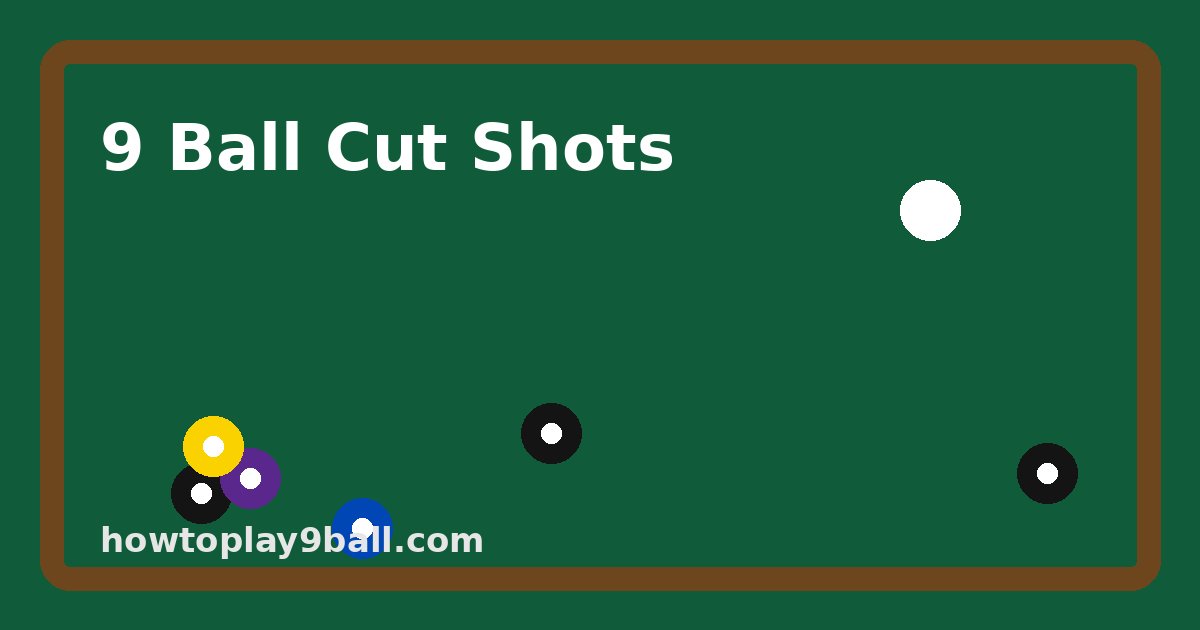
In 9 ball, you do not get to pick which ball to shoot. You must hit the lowest numbered ball first. That means you will face many cut shots, often with the cue ball needing to travel to a certain spot.
Why Cut Shots Matter So Much in 9 Ball
Straight in shots feel easy, but they are hard to play position from. With no angle, you can only draw back, stop, or follow straight forward. A cut shot gives you angle, and angle lets you send the cue ball around the table. Good 9 ball players often leave themselves a small cut on purpose. Read more in 9 ball position play.
How to Aim a Cut Shot
- Find the contact point. Draw an imaginary line from the center of the pocket through the center of the object ball. The spot where that line exits the back of the ball is the contact point.
- Picture the ghost ball. Imagine a cue ball touching the object ball at the contact point. That is the ghost ball.
- Aim at the center of the ghost ball. Send the cue ball there.
- Trust it and stroke. Stay down and follow through.
Thin Cuts vs Medium Cuts
| Cut type | Angle | Tips |
|---|---|---|
| Slight cut | Small angle | Aim almost full, focus on a smooth stroke |
| Medium cut | About a half ball hit | Picture the edge of the cue ball touching the center of the object ball |
| Thin cut | Very sharp angle | Use a soft to medium speed and aim at the very edge |
Thin cuts are where most players miss. Slow down and give them extra time.
Throw on Cut Shots
When balls touch on a cut, friction can push the object ball a little off line. This is called throw. It is strongest on slow, medium cut shots. A little outside english or slightly more speed can reduce it. Just know it exists, and watch where your misses go.
Cue Ball Control After a Cut
On a cut shot, the cue ball heads off along the tangent line, then curves based on spin.
- Follow: The cue ball curves forward from the tangent line.
- Draw: The cue ball curves back from the tangent line.
- Stun: The cue ball goes close to the tangent line at 90 degrees.
Learning these paths is how you get from the 3 ball to the 4 ball with a good angle. See 9 ball cue ball control.
Common Mistakes
- Aiming at the contact point with the cue ball center. This undercuts the ball. Aim at the ghost ball instead.
- Hitting too hard on thin cuts. Speed makes thin cuts harder.
- Steering the cue. Stay straight and let the aim do the work.
- Not planning the cue ball path. Making the ball is only half the job.
Practice Drills
Drill 1: Cut shot ladder. Place an object ball one diamond off a corner pocket. Shoot from straight in, then move the cue ball to make the angle bigger each time.
Drill 2: Same cut, both sides. Practice the same cut to the left and to the right. Most players have a weak side.
Drill 3: Cut and position. Make a cut shot and send the cue ball to a target, like a chalk cube.
For more ways to practice alone, see how to practice 9 ball alone.
The Bottom Line
Cut shots are part of nearly every 9 ball rack. Learn to aim with the ghost ball, control speed on thin cuts, and plan where the cue ball goes. Do that, and you will make more balls and run more racks.
Keep Reading on This Site
- 9 Ball Stop Shot: How to Stop the Cue Ball Dead for Easy Position
- 9 Ball Strategy for Beginners: 8 Simple Ideas to Win More Racks
- How to Rack 9 Ball: A Simple Step by Step Guide
- 9 Ball Soft Break: How a Controlled Break Works and When to Use It
- 9 Ball Pattern Play: How to Plan Your Run From the 1 to the 9
- How to Play 9 Ball Pool: 6 Easy Steps and Key Rules
Frequently Asked Questions
What is a cut shot in 9 ball?
It is any shot where the cue ball hits the object ball at an angle, sending it into a pocket on a different line than the cue ball.
How do I aim a cut shot?
Find the contact point facing away from the pocket, picture a ghost cue ball touching it, and send the cue ball to the ghost ball.
Why do I miss thin cut shots?
Common reasons are too much speed, aiming at the contact point instead of the ghost ball, and steering the cue.
Why are cut shots good for position in 9 ball?
An angle on the shot lets you move the cue ball around the table to reach the next ball.
What is throw on a cut shot?
Throw is when friction between the balls pushes the object ball a little off the expected line.