9 Ball Follow Shot: How to Roll the Cue Ball Forward for Better Position
Quick answer: A follow shot in 9 ball is when you hit the cue ball above center so it keeps rolling forward after it hits the object ball. On a straight shot, the cue ball follows the object ball toward the pocket. On a cut shot, follow bends the cue ball’s path forward. Use a smooth stroke, hit about one tip above center, and control the distance with speed. Follow is one of the most useful tools for getting position in 9 ball.
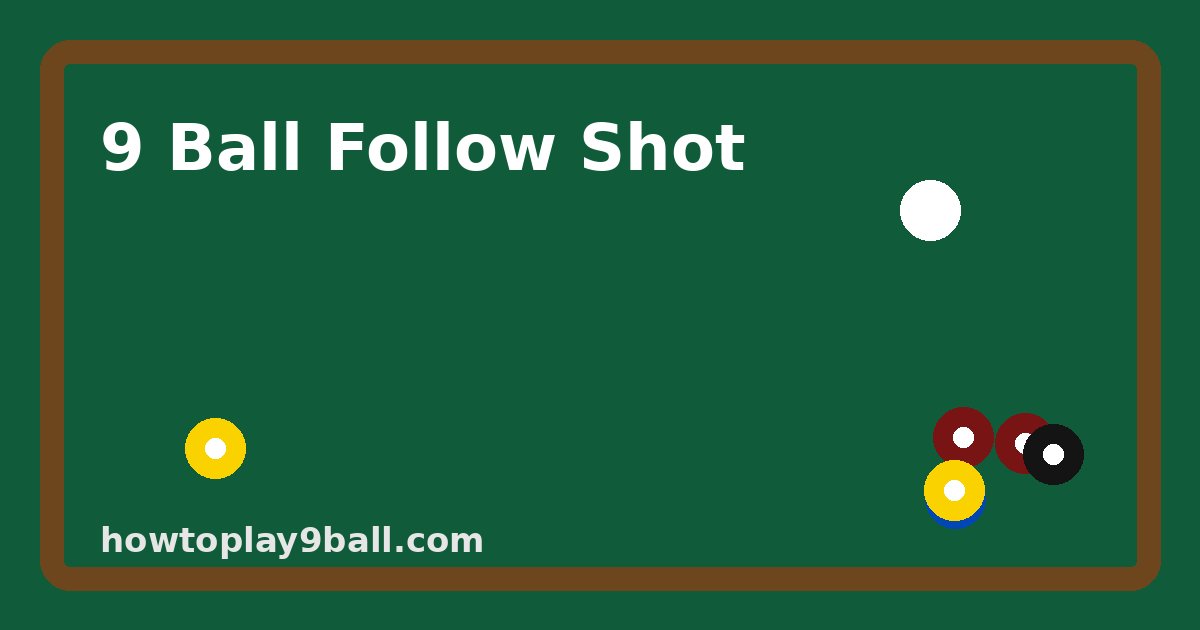
In 9 ball, you must hit the lowest numbered ball first on every shot. That means position is everything. The follow shot helps you move the cue ball forward to the next ball.
How to Hit a Follow Shot
- Aim above center. Start about one tip above the middle of the cue ball.
- Keep the cue level. Raise your bridge a little, but keep the cue as level as you can.
- Stroke smoothly. Do not jab. Let the cue move through the ball.
- Follow through. Let the tip travel a few inches past where the cue ball was.
- Stay down until the cue ball stops.
Follow on Straight Shots
On a straight in shot, a follow hit makes the cue ball roll forward along the same line, toward the pocket. Be careful: too much speed on a short straight shot can send the cue ball into the pocket for a scratch.
Follow on Cut Shots
On a cut shot, the cue ball leaves the object ball at an angle. With follow, the path bends forward. Many players learn the 30 degree rule: on a natural rolling cut that is close to a half ball hit, the cue ball goes off at about 30 degrees from its original line. This helps you guess where the cue ball will end up.
| Hit on the cue ball | What happens after contact |
|---|---|
| Stop or stun (center, with speed) | Cue ball goes off at about 90 degrees on cuts, stops on straight shots |
| Natural roll | Cue ball curves forward, around 30 degrees on many half ball cuts |
| More follow | Path bends forward even more |
Speed Controls Distance
The amount of follow and the speed work together. Soft speed with follow moves the cue ball a short way. Firm speed with follow carries it much farther, often off one or more rails. Practice a few set speeds so you can repeat them.
When to Use Follow in 9 Ball
- To move forward to a ball beyond the object ball
- To go off a rail and come back out toward the next ball
- To avoid scratching when a stun shot would send the cue ball into a pocket
- To get a better angle for the next shot in your pattern
Plan your path before you shoot. Our 9 ball pattern play and 9 ball position play guides show how to think ahead.
Common Follow Shot Mistakes
- Hitting too high and miscuing. Stay within about a tip and a half of center.
- Jacking up the back of the cue, which adds unwanted swerve
- Jerking the stroke
- Forgetting how far the cue ball will roll after contact
Follow Shot Drill
- Set an object ball one diamond from a corner pocket, straight in.
- Put the cue ball two diamonds behind it in a straight line.
- Use soft follow. Try to make the ball and roll the cue ball to stop about a foot from where the object ball was.
- Repeat with medium speed, aiming to roll farther.
- Then move to a small cut angle and watch how the cue ball bends forward.
Do this a few times a week. You will learn exactly how far your follow goes at each speed. Pair it with the 9 ball stop shot so you can choose between stop, follow, and draw on every shot.
Follow vs Draw
Follow moves the cue ball forward. Draw pulls it back. Both are key for 9 ball. Many players find follow easier to control, so it is a good first skill to master. For overall control, read 9 ball cue ball control.
Keep Reading on This Site
- 9 Ball Clusters: How to Spot, Plan for, and Break Up Problem Groups of Balls
- 9 Ball Strategy for Beginners: 8 Simple Ideas to Win More Racks
- How to Rack 9 Ball: A Simple Step by Step Guide
- 9 Ball Soft Break: How a Controlled Break Works and When to Use It
- 9 Ball Pattern Play: How to Plan Your Run From the 1 to the 9
- How to Play 9 Ball Pool: 6 Easy Steps and Key Rules
Frequently Asked Questions
Where do I hit the cue ball for a follow shot?
Hit above center, about one tip up to start. Going too high can cause a miscue.
How far will the cue ball roll with follow?
It depends on your speed and how much follow you use. Practice set speeds to learn your distances.
What is the 30 degree rule in pool?
On many rolling cut shots near a half ball hit, the cue ball leaves the object ball at about 30 degrees from its original path.
Can a follow shot cause a scratch?
Yes. On straight shots near a pocket, too much follow and speed can send the cue ball in after the object ball.
Is follow or draw easier for beginners?
Many players find follow easier to learn first, then add draw for more control.